SigmaEpsilon.Solid.Fourier - Fourier Solutions of Some Plate and Beam Problems in Python#
Version: 2.1.3
Useful links: Installation | Getting Started | Issue Tracker | Source Repository
The sigmaepsilon.solid.fourier library offers semi-analytic solutions to some beam and plate bending problems, where the boundary conditions are a-priori satisfied by careful selection of the approximating functions. Although the calculations only cover a handful of boundary conditions, when they are applicable, they are significantly faster than let say a finite element solution. For this reason, it is very useful for a couple of things:
experimentation
verification
concept validation
education
publication
The implementations in the library all rely on fast and efficient algorithms provided by the goodies of NumPy, SciPy and the likes. Where necessary, computationally intensive parts of the code are written using Numba.
Highlights#
Semi-analytic solutions of beam and plate problems.
Easy to use, high level interface to define various kinds of loads.
Support for arbitrary loads using Monte-Carlo based coefficient determination.
Industry-grade performance based on highly parallel, performant code.
Tight integration with popular Python libraries like NumPy, SciPy, xarray, etc.
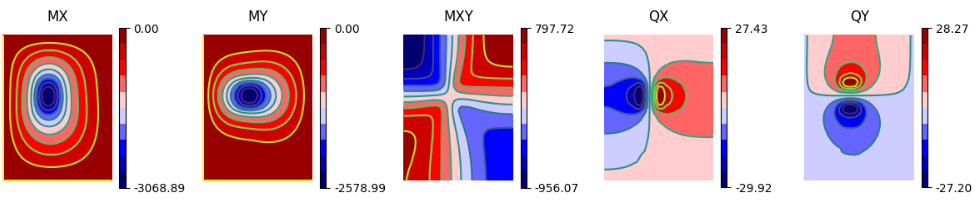
A gallery of examples for plotting with Matplotlib for all types of problems.
A collection of downloadable Jupyter Notebooks ready for execution covering all available functionality.
Getting Started, User Guide and API Reference in the documentation.
The library is intensively tested on CircleCI and has a high coverage level (read more about testing below).
Contents#

Getting Started
The getting started guide is your entry point. It helps you to set up a development environment and make the first steps with the library.

User Guide
The user guide provides a detailed walkthrough of the library, touching the key features with useful background information and explanation.

API Reference
The reference guide contains a detailed description of the functions, modules, and objects included in the library. It describes how the methods work and which parameters can be used. It assumes that you have an understanding of the key concepts.

Contributor’s Guide
Want to add to the codebase? The contributing guidelines will guide you through the process of improving the library.